
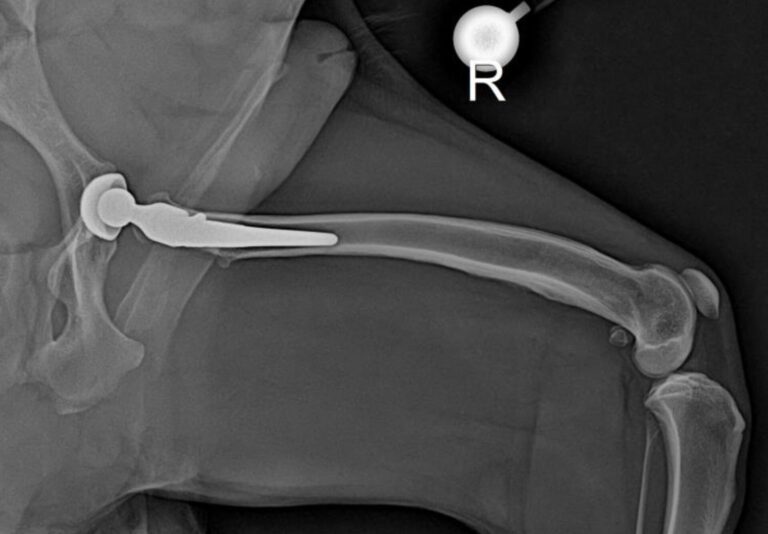
A Samoyed’s Distal Femur Growing Bone: Deciphering Post-THR Periosteal Reaction Through Biomechanics
When young large-breed dogs undergo cementless total hip replacement (THR), postoperative imaging occasionally reveals a surprising phenomenon: periosteal new bone formation along the distal femur. In this case, an 18 kg male Samoyed underwent staged bilateral THR at 9 and 11 months of age due to severe hip laxity. One month after the second surgery, follow-up radiographs revealed marked periosteal reaction along the distal right femur and mild remodeling on the left. Some clinicians instinctively panic at the sight of periosteal changes, suspecting infection or implant failure. However, bone is a living, reactive sculpture. By analyzing Wolff's law, proximal stress shielding, active growth plates, and preoperative subchondral sclerosis, I break down why this distal bone growth represents a benign, mechanically driven adaptive remodeling rather than pathology—and how surgeons should objectively monitor it.
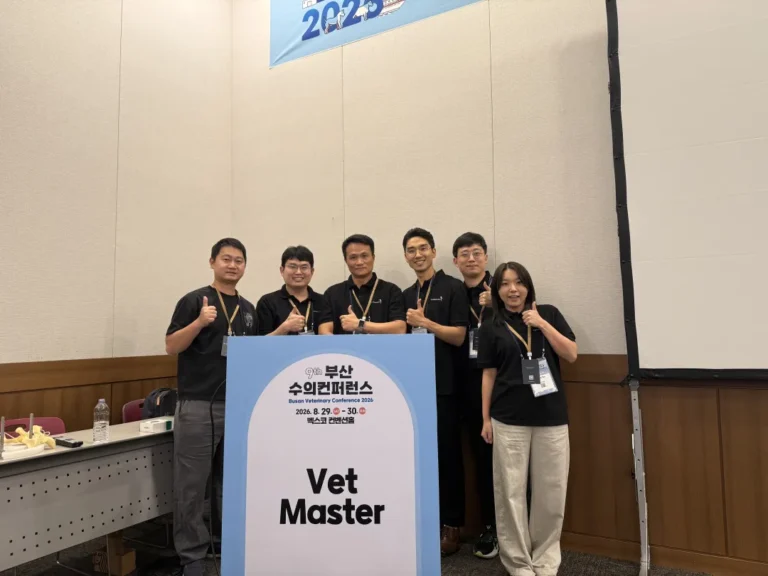
Crossing the Sea: Bringing China’s Vetmaster THR Masterclass to the 9th Busan Veterinary Conference
Just a couple of weeks ago, in late August 2026, I crossed the sea to South Korea alongside my longtime colleague Dr. Dongxing Xu to lead the 2nd Korea Vetmaster Total Hip Replacement (THR) Masterclass, hosted at the 9th Busan Veterinary Conference (BEXCO). Following our sold-out Seoul workshop last year, this two-day intensive seminar drew immense interest from the Korean orthopedic community, selling out within weeks of its July opening. Backed by the milestone of having surpassed 1,000 THR cases earlier this year, I joined distinguished Korean surgeons from Leaders Animal Medical Center to deliver a complete theoretical and practical curriculum—from implant architecture and multi-angular femoral anteversion metrics to live surgical demonstrations. This journey proved once again that Chinese veterinary orthopedics—our domestic pride or "Guohuo ZhiGuang"—is actively setting international standards through sheer clinical precision.
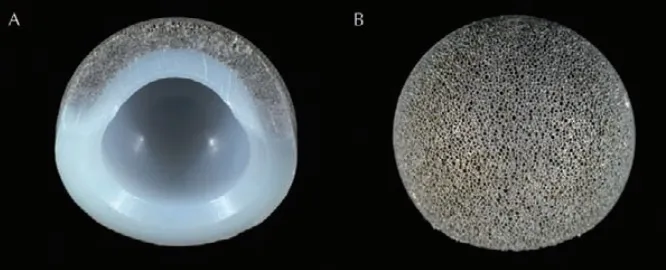
Bone Ingrowth vs. Acrylic Glue: Why Biological Total Hip Replacement Is the Definitive Choice for Cats and Small Dogs
A dangerous myth has circulated in veterinary orthopedics for decades: that delicate, lightweight patients like cats and toy-breed dogs are "adequately served" by 1970s-era acrylic bone cement. Having performed both cemented and cementless procedures over my twenty-three-year career—and having revised far too many loose, infected cement mantles—my clinical conviction is absolute. Bone cement is an inert mechanical grout that never achieves biological fusion; worse, its exothermic curing risks thermal necrosis and Bone Cement Implantation Syndrome (BCIS). Given that cats and small dogs routinely live 15 to 20 years and generate extreme multi-body-height jump forces, relying on a 1 mm plastic mantle is a ticking biomechanical time bomb. Biological 3D-printed titanium implants that achieve true living osseointegration—paired with anti-dislocation dual-mobility articulation—are the only responsible choice. Over the past seven years and through my journey past 1,000 joint replacements, my operating room has maintained an uncompromising 100:1 ratio of biological to cemented hips. Here is the unvarnished science behind that decision.
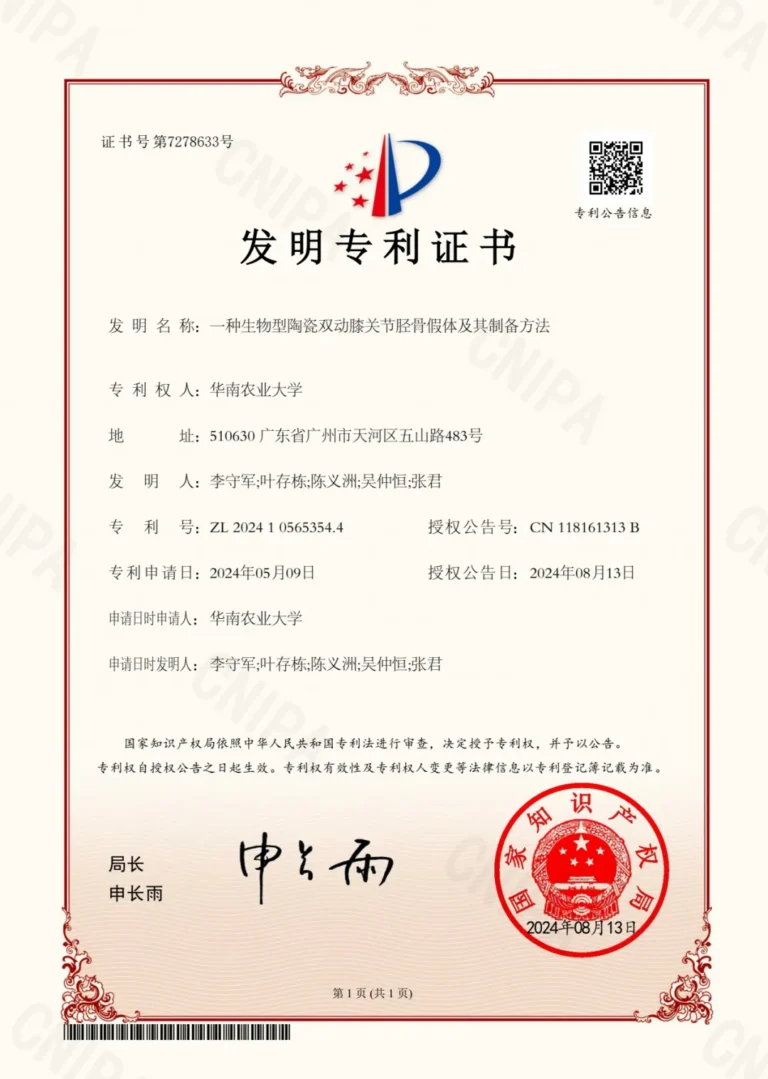
A License to "Brag": Another National Invention Patent in Small Animal Orthopedics
In late 2024, when the official certificate arrived from the National Intellectual Property Administration, I couldn't resist jumping online to do a little completely unapologetic "bragging." Together with our collaborative surgical team at the Clinical Surgery Teaching and Research Section of South China Agricultural University (SCAU), we were officially granted another major National Invention Patent in veterinary orthopedics. In China, thousands of hollow patents are churned out every year simply to check off academic promotion boxes, fulfill university grant quotas, or pad corporate slide decks—only to be discarded as useless paper trophies. Our confidence stems from a completely different reality: this patent was forged under the surgical lamp, vetted through rigorous laboratory trials, and translated into real, 3D-printed biological implants that are actively restoring mobility to animal patients on the operating table.