“When market competition escalates without standardized technical baselines, the line between innovation and reckless compromise becomes dangerously blurred. We needed an enforceable technical safety rope for surgeons, patients, and manufacturers alike.”
— DR. ZHONGHENG WU, LEAD DRAFTER
For years, the domestic veterinary orthopedic sector operated in a regulatory vacuum. The absence of unified manufacturing, fatigue-testing, and biocompatibility criteria meant clinicians operated in a fog—unable to verify whether titanium coatings would shed debris under load or if micro-stems would fracture over millions of gait cycles. When tragic hardware failures triggered industry-wide alarm, the necessity for enforceable standards became inescapable.
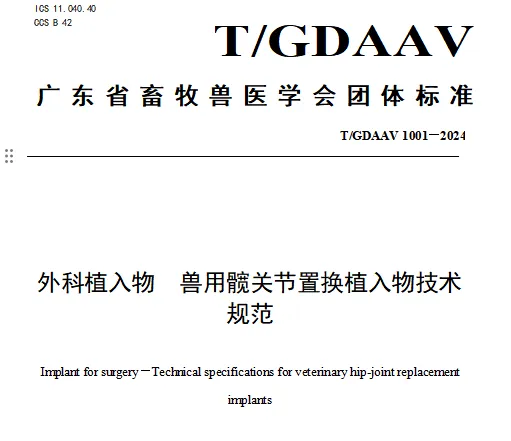
As one of the earliest surgeons in China to perform total hip replacement, I knew passive waiting was unacceptable. Joining forces across clinical practice, academia, and material science—uniting Guangzhou Boshi Animal Hospital, South China Agricultural University (SCAU), Shenzhen YY United Pet Orthopedics, Guangdong Polytechnic of Science and Trade (GPST), and the Institute of New Materials, Guangdong Academy of Sciences—we led the drafting and publication of China’s landmark standard: T/GDAAV 1011–2024 (Implant for Surgery — Technical Specifications for Veterinary Hip-Joint Replacement).