1. Childhood Questions That Never Left
When you were a child looking up at the night sky, did you ever find yourself asking: How big is this universe? How far away are those stars? What is really hiding out there in the infinite dark?
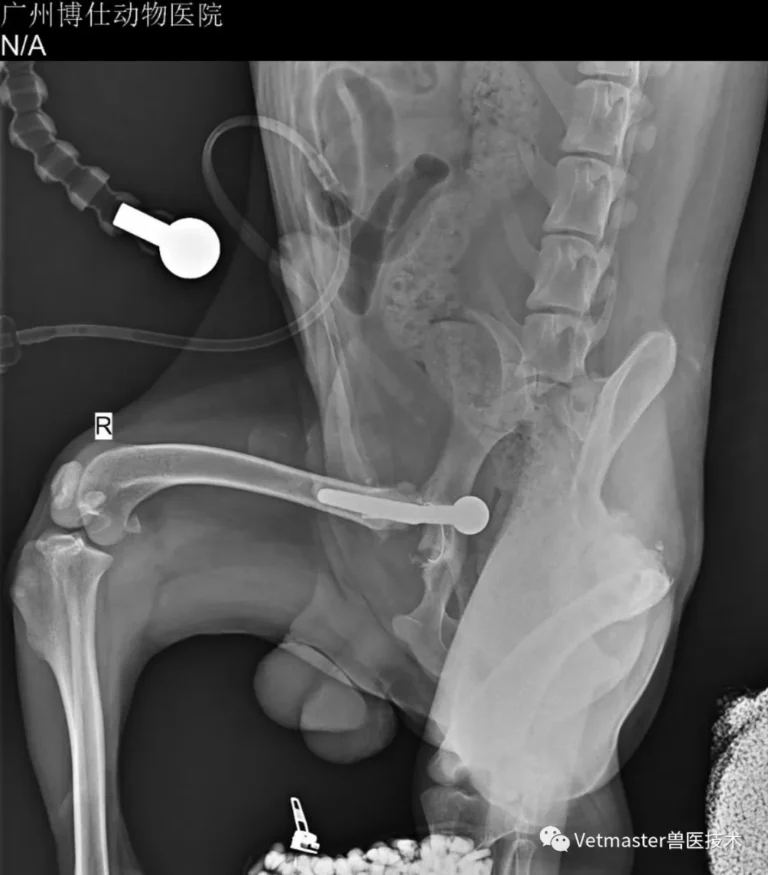
Eventually, we all grow up. We take on professional responsibilities, build careers, and get swept into the momentum of daily life. For me, life became about bone plates, acetabular cups, laminar-flow air systems, and the surgical management of animal joints. Yet even with decades of medical training behind me, I realized I remained just as curious and clueless about those cosmic questions as the boy who first stared up at the Guangzhou sky.
The difference today is that we have tools.
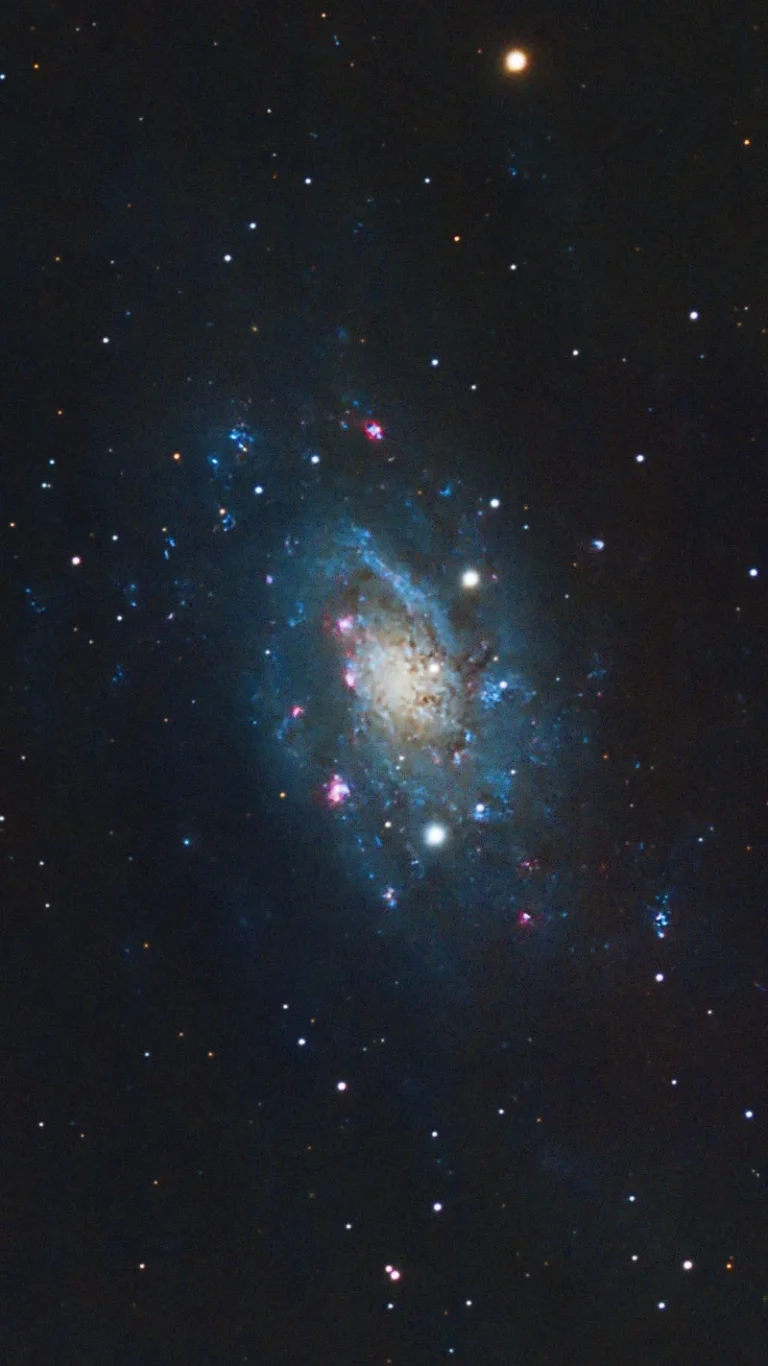
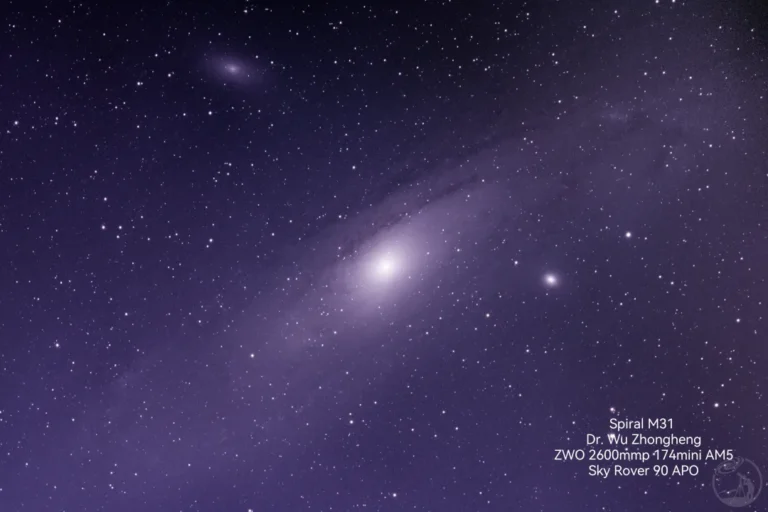
With astronomical telescopes, cooled monochrome cameras, and long-exposure tracking, we don't have to settle for artists' impressions or textbook illustrations. We can cut through the atmosphere and gather the actual, physical photons traveling across deep space. We can reveal a tiny, authentic fragment of cosmic reality with our own eyes and hands.
2. Battling Urban Light Pollution: The Setup
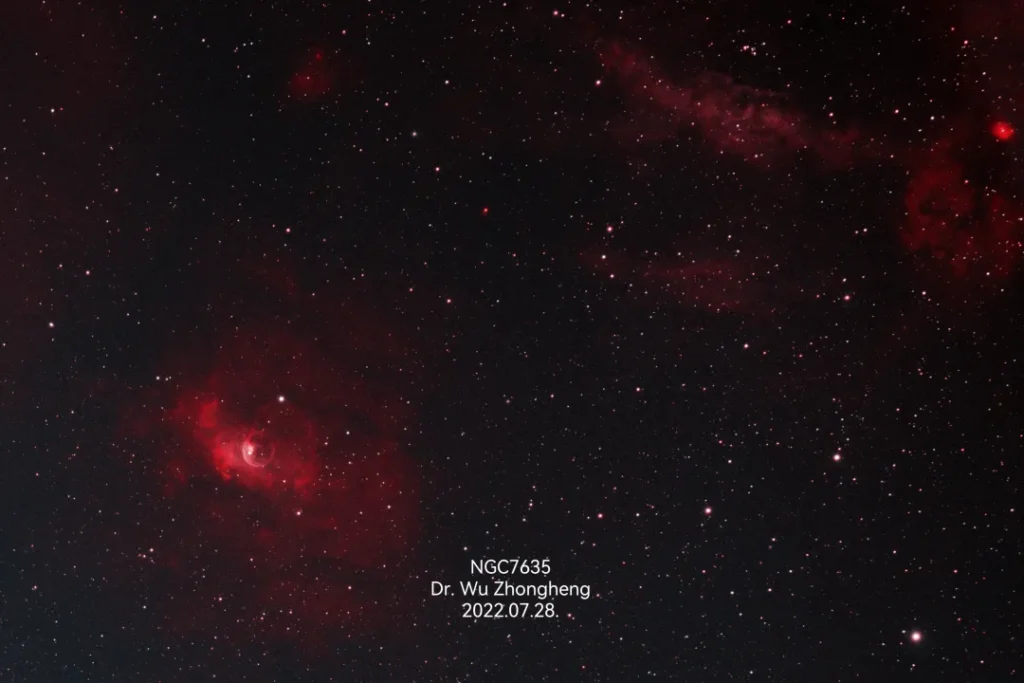
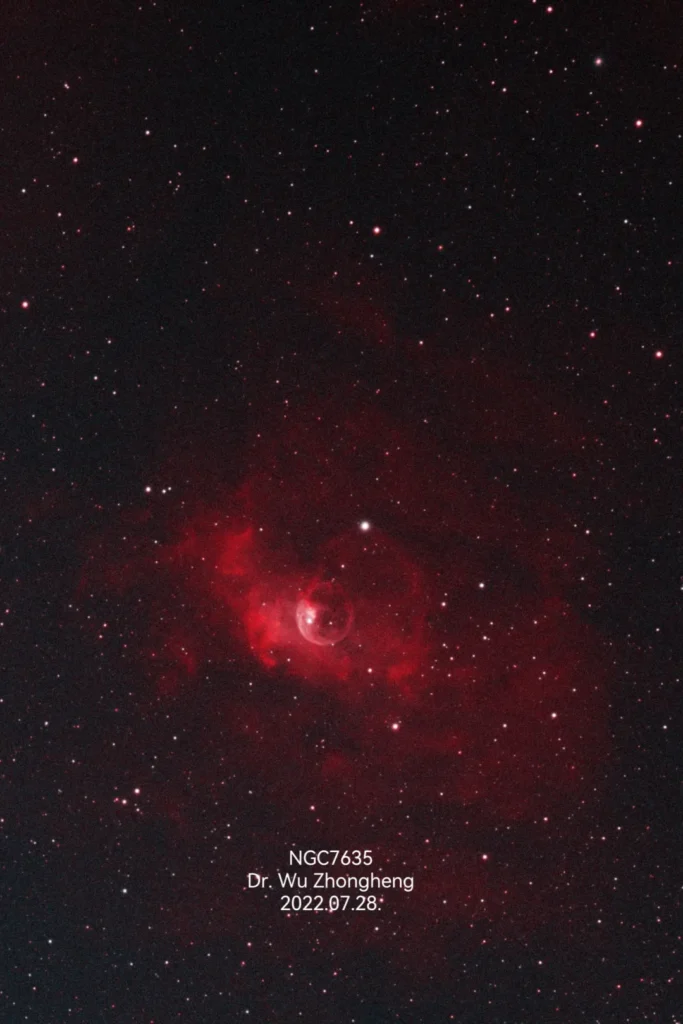
About four years ago, in the summer of 2022, I decided to take on a classic deep-space target: the Bubble Nebula (NGC 7635), an expansive emission nebula floating roughly 7,100 to 11,000 light-years away in the constellation Cassiopeia.
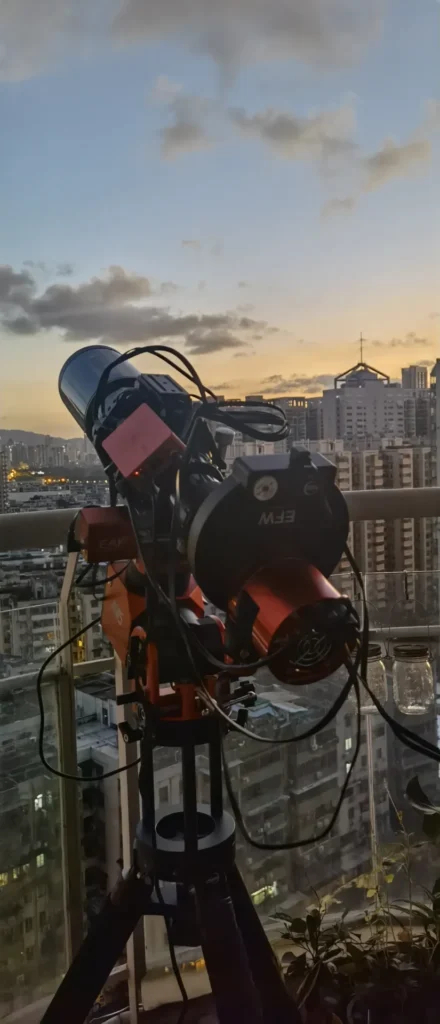
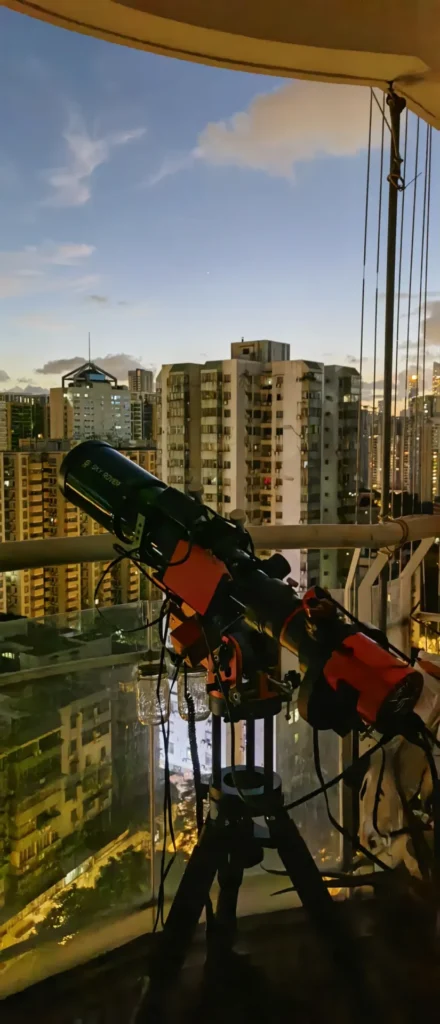
Imaging deep-sky objects from my home in Haizhu District, central Guangzhou, is a constant battle against physics. We live under Bortle 7 to 8 urban light pollution—a blinding wash of commercial neon, streetlamps, and humid river haze. Worse yet, my apartment only has a northeast-facing balcony, which limits my observational field to a narrow sliver of rising sky.
To overcome these constraints, every component of my optical train had to perform with surgical reliability:
- Primary Optical Tube: Sky Rover 90 APO PRO (an apochromatic triplet refractor, 540 mm focal length, native f/6). Fast, color-pure, and completely free of the mirror-alignment headaches associated with reflectors.
- Tracking Mount: ZWO AM5 strain-wave harmonic equatorial mount. Exceptionally stiff, highly responsive, and light enough to deploy on a cramped balcony without vibration.
- Primary Sensor: ZWO ASI2600MM Pro cooled monochrome CMOS camera, chilled to sub-zero temperatures to suppress dark current thermal noise.
- Autoguiding: ZWO ASI174MM Mini paired with an off-axis guide assembly, ensuring our tracking error remained well under an arcsecond during long integrations.
- Automation: ZWO EAF (Electronic Automatic Focuser) to keep focus sharp despite night-to-morning temperature swings, and a 36 mm ZWO EFW (Electronic Filter Wheel).
The secret weapon for defeating severe urban light pollution is ultra-narrowband filtering. I used Optolong 3nm narrowband filters—isolating the precise emission spectra of Hydrogen-alpha (Ha), Oxygen-III (OIII), and Sulfur-II (SII). These filters choke out virtually all city light, letting only the spectral fingerprints of energized interstellar plasma strike the camera's sensor.
3. The Power of Time: 18 Hours of Starlight
In astrophotography, there are no shortcuts. You cannot buy your way past the signal-to-noise ratio; you can only trade time for clarity.
Because my balcony only offered a limited viewing window each night, this project stretched across several evenings:
- Single Sub-exposure: 300 seconds (5 minutes) per frame.
- Total Integration: 210 individual calibrated sub-frames.
- Cumulative Exposure: Approximately 18 hours.
When you examine a single 300-second raw frame, the nebula is barely an impression—a faint, muddy smudge drowning in sensor read noise. But as the integration time climbed past five, ten, and finally eighteen hours, the mathematical magic of stacking took over. Random noise averaged out, and the delicate, spherical shockwave of NGC 7635 began to crystallize.
The central star—an extraordinarily massive, luminous O-type star several hundred thousand times brighter than our Sun—is blasting out stellar winds at thousands of kilometers per second. That wind plows into the surrounding cold molecular cloud, inflating a nearly perfect cosmic bubble ten light-years across. Seeing that delicate sphere take shape on my screen, captured through the dense smog of Guangzhou, was intensely moving.
4. Honest Reflections on the Post-Processing "Wall"
Astrophotography is an unforgiving, interdisciplinary pursuit. You need solid foundations in classical optics, stellar physics, mechanics, and atmospheric science just to capture clean, round stars.
And then, you run straight into the digital wall: image post-processing.
I will be the first to admit that post-processing remains my single biggest technical weakness.
Taking calibrated data through image registration, gradient extraction, linear deconvolution, histogram stretching, and false-color channel combination (the classic Hubble palette of SHO) requires an entirely separate skill set. I used professional astronomical software, relying heavily on automated scripts in PixInsight to handle calibration, star alignment, and basic stretching. But once I reach the limits of what I know how to do in PixInsight, I don’t pretend to be a Photoshop master. More often than not, I export a working TIFF, send it to my phone, and tweak the contrast and tone using everyday mobile apps like Meitu Xiuxiu!
My finished images certainly cannot hold a candle to the breathtaking masterpieces produced by veteran astrophotography masters or professional observatories. But that doesn’t bother me in the slightest.
5. Why We Look Up
In my day job, I operate within strict, measurable parameters: limb alignment angles, surgical plate working lengths, and millimeters of acetabular cup coverage. It is high-pressure, meticulous, and entirely centered on biology.
Astrophotography is where I reset my mind.
It reminds me that beyond our daily stress, our clinical anxieties, and the noise of the city, there is an immense, silent, and breathtakingly beautiful universe spinning in perfect physical harmony.
Capturing that 18-hour bubble from a noisy downtown balcony didn't make me an astrophysicist, nor did it win any photography awards. But it satisfied a boy's curiosity that started decades ago. And for me, that will always be more than enough.