1. The Distant Whirlpool in Camelopardalis
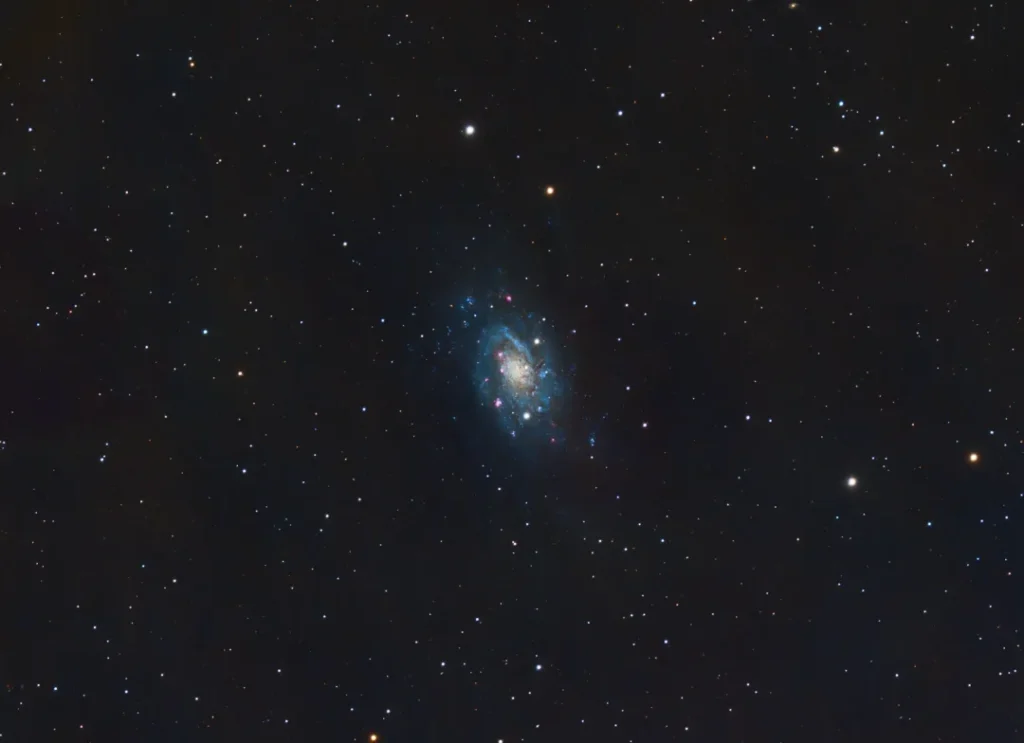
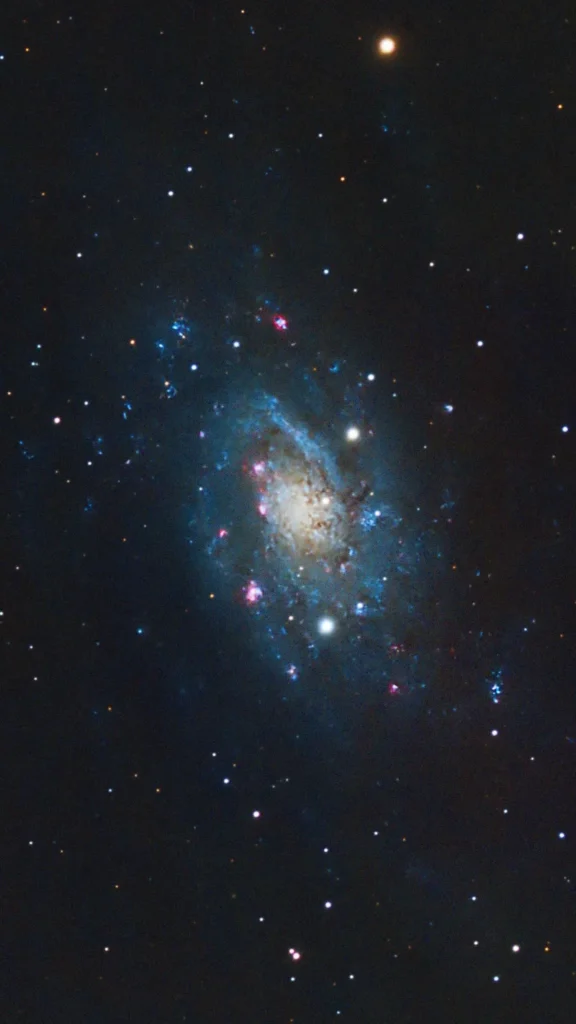
Deep in the northern constellation of Camelopardalis, roughly 8 million light-years from Earth, sits NGC 2403 (cataloged as C7 in the Caldwell catalog).
Discovered by William Herschel in 1788, it is a magnificent intermediate barred spiral galaxy and a prominent outlying member of the M81 Group. Under pristine, pitch-black skies, it is actually quite friendly to observers—you can pick out its glowing core with an ordinary pair of 10 × 50 binoculars.
However, looking at an object through binoculars and attempting to tease out its delicate spiral arms, ionized hydrogen nurseries, and dust lanes with an imaging sensor are two entirely different universes. Especially when your observatory is an apartment balcony in downtown Guangzhou.
2. The 120-Second Ceiling: Battling Bortle 7–9 Skyglow
Back in early 2023, I decided to mount an all-out campaign on NGC 2403 from my home.
The conditions were completely stacked against me:
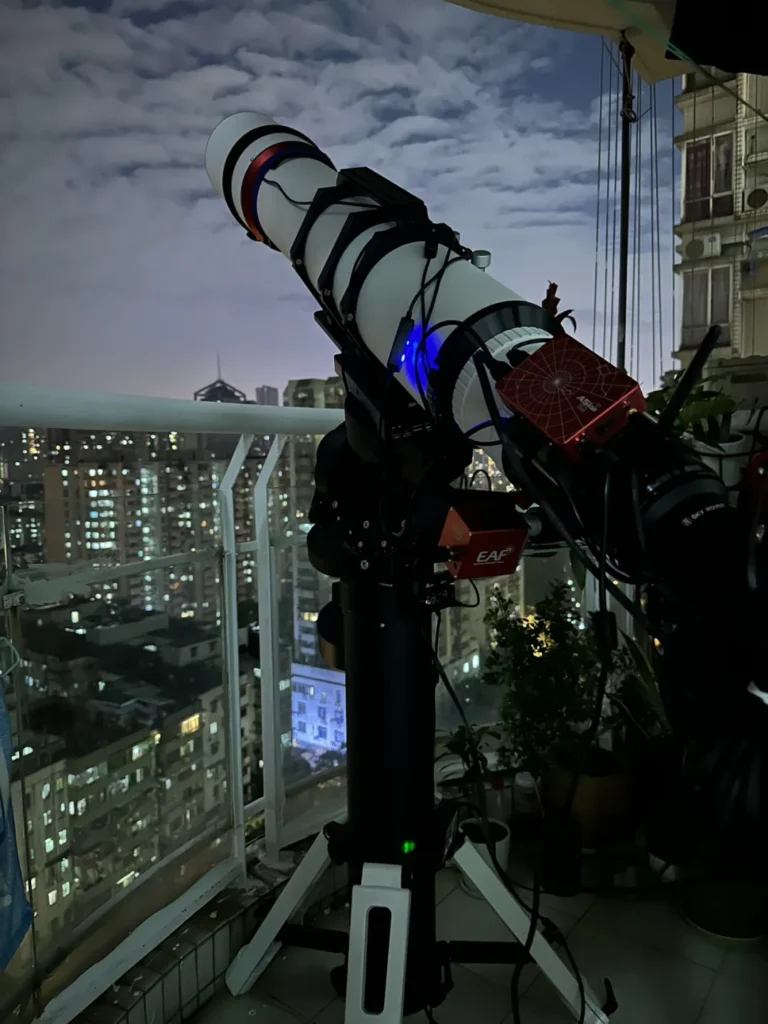
- My telescope sits on a cramped northeast-facing balcony.
- Central Guangzhou suffers from brutal Bortle 7 to 9 urban light pollution.
For dim, diffuse deep-sky targets like galaxies—which emit broad-spectrum light and cannot simply be isolated with narrow emission filters like an emission nebula—this light-polluted bath is devastating.
During test runs, the physics quickly laid down the law: any single sub-exposure pushed past 120 seconds completely overexposed the sensor. The blinding amber wash of urban sodium and LED glare washed out the histogram, drowning the faint photons that had traveled 8 million years just to reach my glass.
When you cannot go deep on individual exposures, you have only one card left to play in astrophotography: brute-force integration.
If the city limits you to 120-second slices, you simply take thousands of them. Over weeks of clear winter nights, whenever Camelopardalis wheeled through my northeastern window, the rig ran continuously. In the end, I racked up approximately 60 hours of total exposure, amassing well over a thousand raw frames.
3. Digital Crunching and the M1 Ultra
Capturing a thousand frames is only half the battle; processing that mountain of data is where the mechanical grind truly begins.
Calibrating, aligning, debayering, weighting, and stacking over a thousand 16-bit uncompressed FITS files is an enormous computational load. If your workstation lacks memory and bandwidth, PixInsight will bring your machine to a grinding halt. To crunch this dataset without bottlenecking, I ran the entire calibration and integration pipeline on a dedicated Apple Mac Studio equipped with the M1 Ultra chip and 128 GB of unified memory.
Even with industrial-grade silicon, navigating subframe weighting and gradient extraction was complex. Throughout the PixInsight workflow, I owe a major debt of gratitude to my friend "Fei Zong", an exceptional veteran astrophotographer whose generous, step-by-step technical guidance helped me conquer the steeper learning curves of image processing.
4. What Is the Point of Balcony Astrophotography?
Whenever friends or colleagues see me nursing coffee after spending all night tending a mount, they inevitably ask the pragmatic question: What is the point?
After all, a veterinary surgeon spending thousands of hours and substantial money to produce an image of a galaxy that the Hubble Space Telescope or James Webb has already resolved in blistering, multi-million-dollar detail seems completely irrational. As we say colloquially in Cantonese: on paper, it doesn't have a shred of practical use. It won't cure a patient, it won't optimize a femoral stem, and it won't bring in a dime of revenue.
And yet, that is precisely why it matters.
In our adult professional lives, almost everything we do is measured by efficiency, commercial value, and practical outcomes. Astrophotography is my rebellion against that utilitarian mindset. It is about keeping childhood wonder alive—protecting that raw, unvarnished curiosity about how the physical universe functions and pursuing beauty simply because it exists.
To me, taking the time to truly understand focal ratios, stellar magnitudes, tracking errors, and Fourier transforms is inherently fascinating. Every hour spent working out those principles is an hour well spent.
5. Looking Ahead: The Dream of Darker Skies
This 60-hour marathon on NGC 2403 taught me the hard biological and optical limits of shooting from an urban balcony. You can fight light pollution with stacking algorithms and silicon horsepower, but you cannot rewrite the laws of physics.
My long-term dream is to eventually move my optical setups out of the city smog and build a private remote observatory under genuine Bortle 1 or 2 dark skies. Out there, away from streetlamps and high-rises, these distant galaxies can finally be recorded with the pristine clarity and cosmic silence they deserve.
Until that day comes, I will keep shooting from my balcony—one 120-second frame at a time.