1. Breaking Good News: Time for Some Honest "Bragging"
Back in the autumn of 2024, our team received another official red-ribbon notice from the National Intellectual Property Administration: together with my colleagues at the Clinical Surgery Teaching and Research Section of South China Agricultural University (SCAU), our latest National Invention Patent in small animal orthopedics had cleared substantive examination and received full authorization.
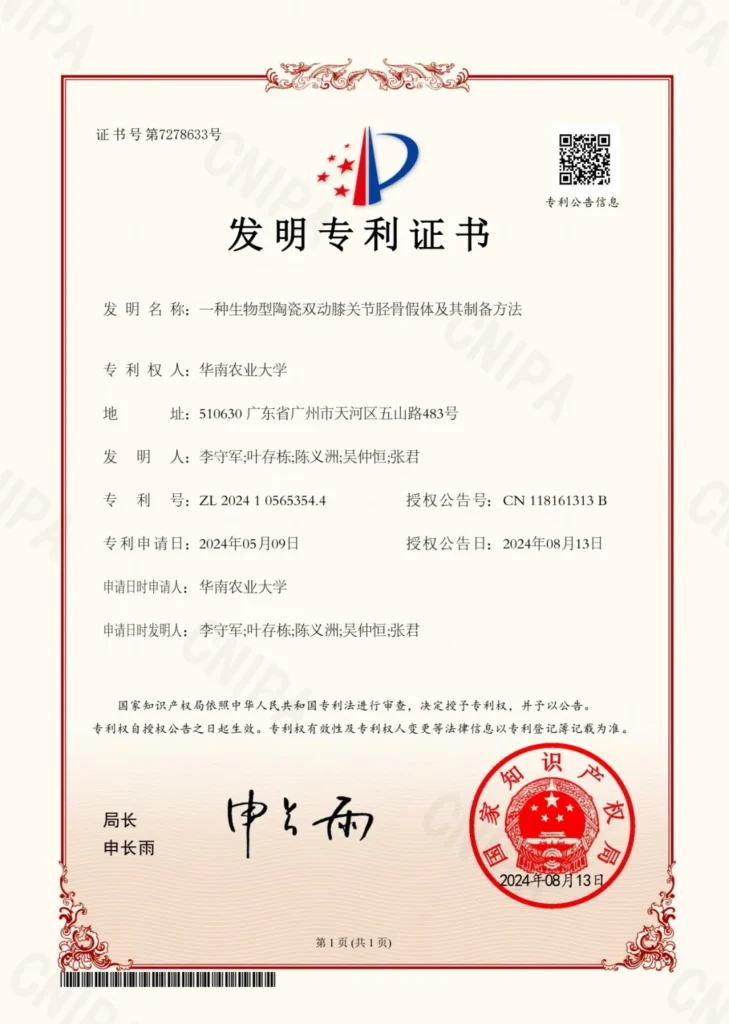
Whenever one of these official certificates lands on my desk, my first reaction is always the same: it’s time to hop online and do some unapologetic bragging!
Around here, some folks might wonder: Dr. Wu, you are an experienced surgeon and a doctoral clinician; isn't bragging about a patent a bit undignified?
I laugh every time I hear that. If someone is peddling hollow academic buzzwords without a shred of clinical proof, that is empty boasting. But when an orthopedic patent is conceived from brutal clinical dilemmas, validated through years of cross-disciplinary biomechanical testing, and successfully engineered into hardware that saves animal limbs every single week—that isn't empty posturing. That is hard-earned clinical pride.
2. Decoding Patents: Why "Invention" Patents Actually Matter
To those unfamiliar with the legal machinery of intellectual property, the word "patent" sounds uniform—as if filing a few pages of legal jargon automatically proves engineering genius. In reality, patents in China are divided into three strictly tiered categories:
- Design Patents: Protecting purely aesthetic outer contours or cosmetic packaging.
- Utility Model Patents: Protecting minor mechanical tweaks or functional structural modifications. Relatively straightforward to draft and quick to grant without deep scrutiny.
- Invention Patents: The undisputed gold standard of intellectual property.
Securing a National Invention Patent is an entirely different beast.
It does not get rubber-stamped. It undergoes years of exhaustive, adversarial substantive examination by state patent examiners, scrutinizing absolute worldwide novelty, inventive non-obviousness, and practical industrial utility. Anyone with an afternoon to spare can file a decorative design patent, but earning a certified Invention Patent in orthopedic hardware demands ironclad biomechanical data, stress-testing logs, and genuine technical innovation that pushes past existing boundaries.
3. Calling Out "Paper Trophies" and Zombie Patents
Let’s be completely candid about the uncomfortable reality of domestic patents: an overwhelming percentage of them exist purely as useless paper trophies.
Across the academic world, thousands of patents are churned out every single year for reasons that have nothing to do with solving real-world problems:
- Universities crank them out to satisfy government research project KPIs.
- Clinicians and faculty members write them to check off mandatory checkboxes for academic title promotions.
- Graduate students churn them out to fulfill institutional quotas for master’s and doctoral degrees.
- In the commercial sector, startup companies amass superficial patents to inflate their registered capital on paper, impress venture capitalists in pitch decks, or scrounge together minor soft assets to liquidate when the business goes belly-up.
Once the framed certificates are hung on a lobby wall, they are forgotten. They never touch a precision CNC milling machine, they never enter an additive manufacturing chamber, and they never relieve the pain of a single living creature.
In fact, the problem became so egregious that China's National Intellectual Property Administration launched massive crackdowns, officially invalidating millions of these low-quality, non-practicing "zombie patents."
4. What Gives Us the Right to Stand Tall
The reason I feel proud of the patents coming out of our team is that our work represents genuine, authentic industry-academia-clinical translation.
We don't sit in an isolated office daydreaming theoretical geometries. Every single patent we file is born directly out of a frustrating, high-stakes problem encountered on the surgical table:
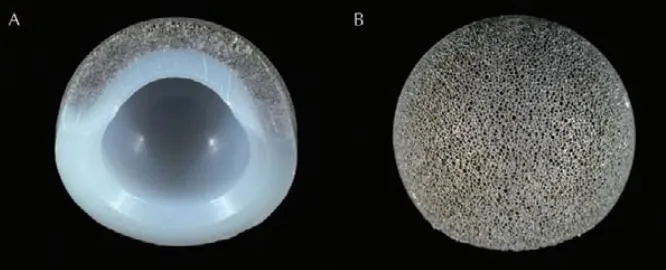
- How do we engineer 3D-printed trabecular pore interconnectivity to achieve immediate biological press-fit in a fragile, osteoporotic bone bed?
- How do we eliminate micro-motion and rotational loosening in an ultra-compact 10 mm feline acetabular cup?
- How do we design a biological knee prosthesis that provides absolute anti-dislocation jump distance without restricting multi-axial stifle kinematics?
Our intellectual property moves along an unbroken, disciplined pipeline:
Clinical Problem Identified in the Operating Theater → Biomechanical Design & Testing with SCAU and the Guangdong Academy of Sciences → Invention Patent Clearance → Standardized Manufacturing → Clinical Surgical Application.
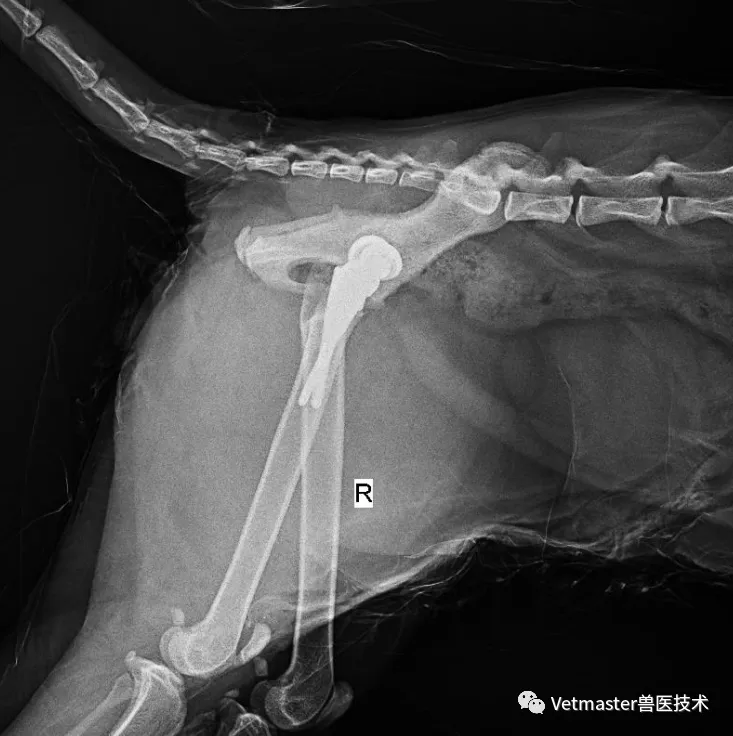
When a surgical team does the authentic research, drafts the patent, navigates state examinations, and then actually turns that blueprint into medical-grade titanium and cobalt-chromium implants that restore running mobility to hundreds of crippled animals across the country—that carries genuine weight.
A patent that stays on paper is just an expensive receipt. A patent that lives inside living bone to heal disease has a soul.
And that is something worth bragging about any day of the week.