1. Case Background and Clinical Examination
1.1 Patient Profile
The patient was a 6-month-old puppy. The primary complaint from the owner was abnormal hind limb gait characterized by severe external rotation (out-toeing).
1.2 Diagnostic Findings
Clinical and radiographic evaluations confirmed the presence of hip dysplasia (CHD). Key findings included significant joint laxity and insufficient acetabular coverage of the femoral heads. Furthermore, the chronic abnormal weight-bearing had resulted in secondary skeletal malalignment, manifesting as severe out-toeing.
2. Surgical Intervention Strategy
2.1 Application of Double Pelvic Osteotomy (DPO)
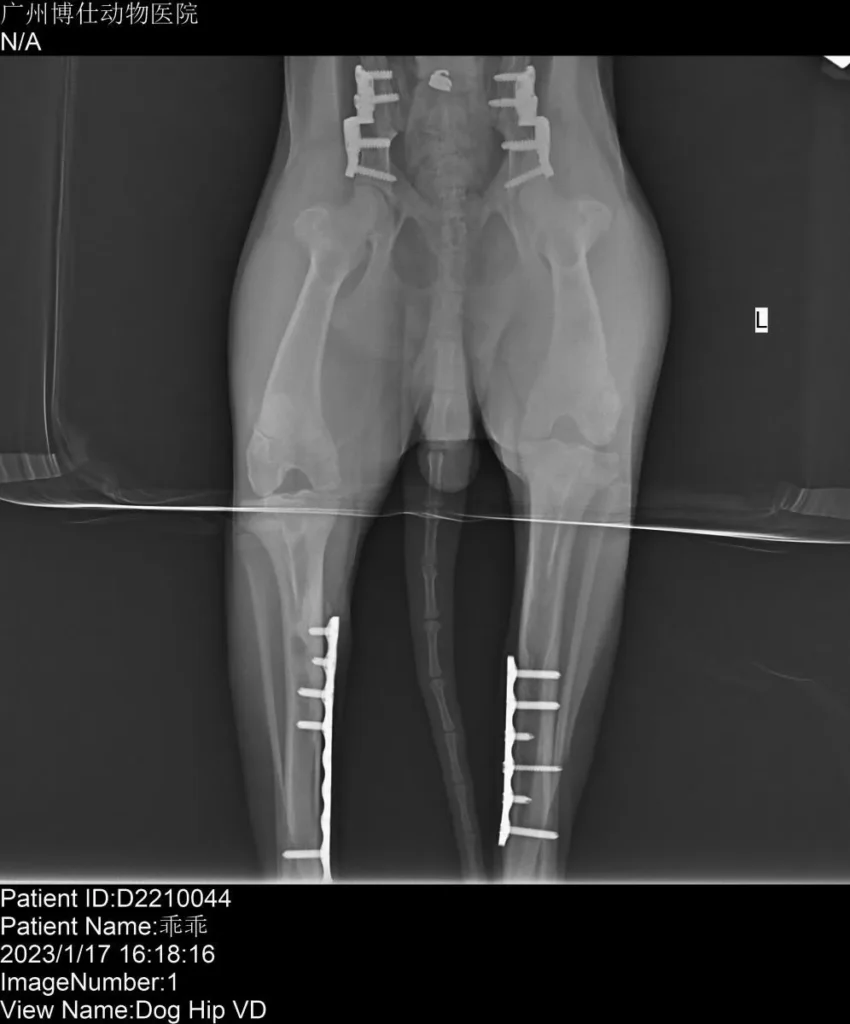
To address the hip laxity and coverage deficit, the surgical team elected to perform a Double Pelvic Osteotomy (DPO). The objective of this procedure was to rotate the acetabulum to increase its coverage of the femoral head, thereby restoring biomechanical stability to the joint.
2.2 Correction of Limb Deformity
To resolve the patient's severe external rotation, a distal tibial osteotomy was performed concurrently with the DPO. This combined surgical approach aimed to address both the internal joint instability and the external alignment deformity in a single stage.
3. Postoperative Follow-up and Efficacy Assessment
3.1 Mid-term Recovery
The puppy’s recovery was uneventful. Radiographic re-evaluation at three months postoperatively demonstrated that the hip joints had regained normal coverage, and the previous laxity was completely resolved.
3.2 Functional Alignment Improvement
Follow-up observations indicated that the hind limb out-toeing had been corrected to the greatest extent possible, and the gait returned to near-normal levels. Early intervention successfully prevented further articular wear and the development of degenerative osteoarthritis.
4. Clinical Reflections and Conclusion
4.1 Balancing Corrective vs. Salvage Procedures
While I am widely recognized for performing high volumes of Total Hip Replacements (THR), it is important to understand that THR is essentially a "salvage procedure." It is an option reserved for when the hip joint is damaged beyond repair.
4.2 The Value of Preserving the Native Joint
I much prefer to see animals utilize their "original" hip joints. Through corrective surgeries like DPO, the patient is allowed to retain a normal, healthy, and natural joint structure.
4.3 The Primacy of Early Diagnosis
This case serves as a powerful reminder of the importance of early diagnosis. Detecting CHD early provides the opportunity for early correction, which can halt the progression of the disease. For owners, this translates to lower risks and costs; for the animals, it ensures a much more comfortable and high-quality life.